Botox has come a long way since its early days, and 2026 brings some exciting developments that make treatments more personalized, natural-looking, and effective than ever before. Whether you’re considering your first Botox treatment or looking to optimize your current routine, this comprehensive guide covers everything you need to know about Botox in the modern era.
What Makes 2026 Different for Botox Treatments
The biggest shift we’re seeing this year is the move away from the “frozen” look that defined early Botox treatments. Today’s approach focuses on preventative aging and facial wellness, creating subtle enhancements that preserve your natural expressions while smoothing away unwanted lines.
Key trends shaping Botox in 2026 include:
Microdosing Revolution: This technique uses smaller amounts of Botox distributed across targeted areas, allowing for more natural movement while still achieving wrinkle reduction. It’s particularly popular among patients in their 30s who want to prevent deeper lines from forming.
Personalized Treatment Plans: Gone are the days of one-size-fits-all dosing. Modern providers customize treatments based on your age, muscle strength, skin elasticity, lifestyle, and how you’ve responded to previous treatments.
Full-Face Approach: Rather than treating isolated areas, many patients now opt for comprehensive facial rejuvenation that addresses multiple regions for overall balance and harmony.
Advanced Technology Integration: AI imaging and ultrasound guidance help providers identify asymmetries, recommend optimal dosing zones, and visualize important structures before injection, making treatments safer and more precise.
How Botox Works in Your Skin
Botox® and similar neuromodulators are purified forms of botulinum toxin type A that temporarily block nerve signals to facial muscles. When these muscles can’t contract as strongly, the skin above them smooths out, reducing the appearance of dynamic wrinkles – those lines that form from repeated facial expressions like smiling, frowning, or squinting.
How It Works: The treatment prevents the release of acetylcholine, a neurotransmitter that triggers muscle contractions, resulting in temporary muscle relaxation in the targeted areas.
Timeline & Results:
- Onset: Effects typically become noticeable within 3-7 days
- Peak results: Full effect is usually visible around 2 weeks post-treatment
- Duration: Results generally last 3-6 months, though this varies based on several factors
Factors Affecting Duration:
- Individual metabolism and muscle strength
- Injection technique and dosage used
- Specific treatment area (forehead, crow’s feet, frown lines, etc.)
- Frequency of previous treatments (regular users may experience longer-lasting results)
- The specific brand used (Botox®, Dysport®, Xeomin®, Jeuveau®, or Daxxify®)
Note on Formulations: While “Botox” is often used generically, it’s actually a specific brand by Allergan. Other FDA-approved botulinum toxin type A products include Dysport, Xeomin, Jeuveau, and the newer Daxxify, which may last up to 6-9 months. Each has slightly different characteristics in terms of onset time, spread, and duration.
Popular Treatment Areas
Modern Botox treatments can address numerous areas of concern:
Classic Areas:
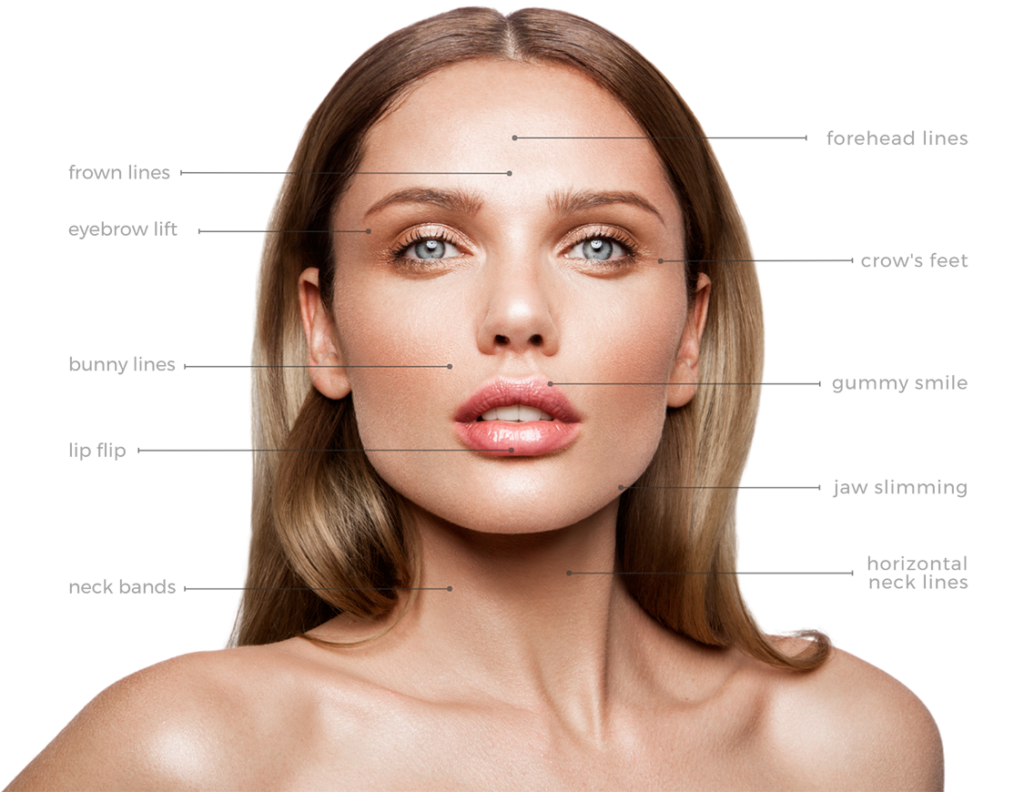
- Forehead lines (horizontal wrinkles)
- Frown lines (the “11s” between your eyebrows)
- Crow’s feet (lines around the eyes)
Expanding Applications:
- Bunny lines on the sides of the nose
- Lip lines and gummy smile correction
- Chin dimpling and orange peel texture
- Neck bands for a smoother neckline
- Masseter muscles for jawline slimming and TMJ relief
- Trapezius muscles (“trap tox”) for neck tension relief
Dosing Considerations: Dosing varies by treatment area and individual factors. For example, forehead lines may require 10-30 units, frown lines typically need 20-25 units, and crow’s feet require 12-24 units total (both sides). Your provider will determine the appropriate dosage based on your muscle strength, treatment goals, and facial anatomy.
Understanding Different Botox Formulations
Today’s market offers several neuromodulator options, each with unique characteristics:
Allergan Botox® (USA): The gold standard with high purity and narrow molecular dispersion for precise application. Effects typically last 3-4 months, with some patients experiencing results up to 5 months.
Dysport® (France/Ipsen): Features wider molecular dispersion, creating softer, more natural-looking results. Particularly effective for large muscle groups. Onset is typically faster (2-3 days) than Botox, with duration of 3-5 months.
Xeomin® (Germany): Contains no accessory proteins, reducing the risk of developing antibody resistance. Duration is typically 3-4 months.
Jeuveau® (USA): A newer option with similar characteristics to Botox, lasting 3-4 months.
Daxxify® (USA): The newest long-lasting formulation that typically provides results for 6-9 months, significantly longer than traditional neuromodulators. This extended duration makes it ideal for patients seeking less frequent maintenance.
Your provider will select the best formulation based on your specific anatomy, aesthetic goals, and treatment history rather than following trends.
The Modern Botox Treatment Process
Today’s Botox treatments are more comfortable and efficient than ever:
Consultation: Your provider will assess your facial anatomy, discuss your goals, and review your medical history to create a personalized treatment plan. This is also when contraindications are evaluated.
Preparation: The treatment area is cleansed with antiseptic solution. Some providers may apply topical numbing cream for sensitive patients.

Injection: Using ultra-fine needles, Botox is strategically injected into specific muscles. Most patients describe the sensation as minor pinpricks. The entire injection process typically takes 10-15 minutes.
Immediate Aftercare: Ice may be applied to minimize swelling or bruising. The complete appointment typically takes 15-30 minutes.
Maintenance and Aftercare
Scheduling: Most patients schedule maintenance treatments every 3-4 months to maintain optimal results. With longer-lasting formulations like Daxxify, some can extend this to 6-9 months between treatments.
Post-Treatment Care:
- Avoid intense exercise for 24 hours
- Skip alcohol on treatment day
- Don’t lie down for the first 4 hours after injection
- Avoid facial massage or manipulation for 24 hours
- Use gentle skincare products for the first few days
- Stay upright and avoid bending over excessively
Timeline for Results:
- Onset: Effects typically become noticeable within 3-7 days (Dysport may show results in 2-3 days)
- Peak results: Full effect is usually visible around 2 weeks post-treatment
- Duration: Results generally last 3-4 months for traditional formulations, 6-9 months for Daxxify
The Appeal of Microdosing
Microdosing has become incredibly popular because it offers several advantages:
- Natural Results: Maintains facial expressiveness while softening lines
- Early Intervention: Perfect for patients in their late 20s and 30s preventing deeper wrinkles
- Lower Risk: Minimal chance of overtreatment or unwanted side effects
- Gradual Approach: Ideal for first-time patients easing into neuromodulator treatments
- Customizable: Allows for subtle adjustments over time
Full-Face Rejuvenation Approach
Rather than targeting isolated problem areas, today’s comprehensive approach often includes:
- Brow lifting with forehead relaxation
- Softening downturned mouth corners
- Chin texture improvement
- Jawline refinement
- Neck smoothing for an elongated profile
When combined with complementary treatments like microneedling with PRP, dermal fillers, or professional skincare, results become more comprehensive and longer-lasting.
Important Safety Information
Who Should NOT Get Botox:
- Pregnant or nursing women
- Individuals with certain neurological conditions (myasthenia gravis, Lambert-Eaton syndrome, ALS)
- Those allergic to botulinum toxin or any ingredients in the formulation
- Active infection at the injection site
- Those taking certain medications (discuss with your provider)
Potential Side Effects: Botox has an excellent safety profile when administered by qualified professionals. Side effects are typically mild and temporary, including:
- Slight bruising or swelling at injection sites
- Temporary headache
- Mild drooping (rare, typically resolves within 2-4 weeks)
- Flu-like symptoms (uncommon)
Serious complications are rare but can occur if injections are performed incorrectly.
Antibody Resistance: While rare, repeated use of neuromodulators can lead to antibody development, reducing effectiveness over time.
Choosing the Right Provider
The success of your Botox treatment depends heavily on your provider’s expertise. Look for:
- Board certification in dermatology or plastic surgery
- Extensive experience with neuromodulators (ask how many treatments they perform monthly)
- A comprehensive consultation process
- Before and after photos of their work
- A focus on natural-looking results
- Up-to-date knowledge of latest techniques and products
- Transparent pricing and realistic expectations
Cost Considerations
Botox pricing varies based on geographic location, provider expertise, and the number of areas treated. In Arizona, expect to pay $10-20 per unit, with typical treatments ranging from $200-600 depending on areas treated.
While it might be tempting to seek the lowest price, remember that Botox is a medical procedure requiring skill and precision. Quality providers invest in ongoing education, premium products, and safety protocols that justify their fees.
Many practices offer package deals for multiple areas or loyalty programs for regular patients, making treatments more affordable over time.
Realistic Expectations
It’s important to have realistic expectations – Botox smooths dynamic wrinkles (those caused by muscle movement) but won’t address:
- Static lines (wrinkles present at rest)
- Sun damage or pigmentation
- Volume loss or sagging skin
- Skin texture issues
For comprehensive facial rejuvenation, your provider might recommend combining Botox with other treatments such as dermal fillers, laser resurfacing, or skincare regimens.
The Future of Neuromodulators
As we move through 2025-2026, expect continued innovations in formulations, injection techniques, and combination therapies. The focus remains on achieving natural, refreshed results that enhance rather than dramatically alter your appearance.
Emerging trends include:
- Longer-lasting formulations
- More precise targeting techniques
- Combination protocols for comprehensive rejuvenation
- Preventative treatments starting at younger ages
- Customized dosing based on facial analysis technology
Ready to Get Started?
If you’re considering Botox, now is an excellent time to explore your options. With more choices, better techniques, and a deeper understanding of facial anatomy, today’s treatments offer safer, more effective results than ever before.
Contact Arizona Skin Institute to schedule a consultation with our experienced dermatology team. We’ll create a personalized treatment plan tailored to your unique aesthetic goals.
This information is for educational purposes only and does not constitute medical advice. Individual results may vary. Always consult with a qualified healthcare provider to determine if Botox is right for you.

Exploring Botox and Dysport in 2024
In the quest for youthful, rejuvenated skin, cosmetic treatments have become increasingly popular. Among these, Botox and Dysport stand out as effective solutions for reducing wrinkles and achieving...

Skin Cancer Prevention for Outdoor Workers in Sunny Arizona
Working outdoors in Arizona requires keeping your skin healthy and protected from the harsh, unforgiving sun. With year-round warm weather and over 300 days of sunshine, cumulative sun exposure and...
Acne Treatments and Prevention Strategies
Acne, a common skin condition affecting people of all ages, can be a persistent and frustrating challenge for many. As we navigate the complexities of skincare, understanding effective acne...

Why SRT Is the Future of Non-Melanoma Treatment
Basal cell carcinoma (BCC) and squamous cell carcinoma (SCC) are the most common types of non-melanoma skin cancers. Historically, the predominant treatment protocols involved invasive procedures,...

Nurturing Your Skin In Cold Conditions
As the temperature has dropped here in Arizona, these past few weeks, our skin often faces challenges that require special attention. Cold weather can strip away the skin’s natural moisture, leaving...
Arizona’s High Melanoma Rates and What You Can Do
Arizona's estimated skin cancer incidence rate is above the U.S. national average, according to Axios and the American Cancer Society (ACS). By the numbers, the Grand Canyon State's annual melanoma...
Trends In Skin Care For 2024
As we step into the new year, the world of skincare is evolving at an unprecedented pace. With advancements in technology, a deeper understanding of skin biology, and a growing emphasis on...
Schedule An Appointment
Surprise
Buckeye
